


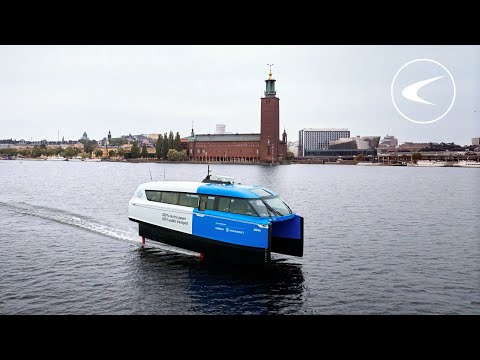
Swedish company Candela is developing electric hydrofoil ferries—most notably the Candela P-12 model, which is designed to be part of urban public transport systems. These vessels truly "fly" over the water: as they accelerate, the hydrofoils lift the hull, allowing the ferry to move almost without wake and nearly silently at a speed of about 25 knots (approximately 46 km/h).
What makes the Candela P-12 special
- A Hybrid of Wings and Electricity: at speeds above roughly 18 knots, the hydrofoils lift the hull, which reduces water resistance by approximately 80% and sharply decreases energy consumption.
- Electric Drive: the ferry operates on batteries, emitting no harmful exhaust into the atmosphere and leaking no fuel or oil into the water. This makes it an environmentally friendly solution for urban and coastal routes.
- Automatic Control: computers, sensors, and software adjust the angle of the foils up to 100 times per second, stabilizing the vessel and smoothing out the motion. This makes trips much more comfortable and reduces the risk of seasickness.
- The Candela P-12 is designed for 25–30 passengers (depending on the configuration), reaches a cruising speed of about 25 knots, and can travel around 40 nautical miles (about 74 km) on a single charge. Such a format is convenient for short urban routes, shuttle services, and crossings between suburbs and the centers of major cities.
- Economics and Ecology: Why It Is Needed
- More Cost-Effective than Diesel: by reducing energy consumption, Candela claims a reduction in "fuel" costs of about 80% compared to traditional diesel ferries. This lowers operating costs and makes water routes more attractive to city and regional authorities.
- Less Noise and Coastal Impact: the lack of loud motors and minimal wake reduces noise pollution and shoreline erosion, which is especially important for sensitive coastal and tourist areas.
The company is already supplying the Candela P-12 to Saudi Arabia, Norway, and several other countries; for 2026, Norway has ordered the world's largest fleet of electric hydrofoil ferries—about 20 vessels.
Bringing People Back to the Water
Hasselskog, the head of Candela, emphasizes that waterways are the oldest form of transport, but they have been pushed into the background in recent decades. Electric "flying" ferries are an attempt to integrate water routes into modern urban transport systems.
The idea is simple:
- instead of two or three ferries a day—several shuttles that run every 10–15 minutes, like a nautical equivalent of a city bus or metro;
- a passenger can come to the pier without checking the schedule and board the next P-12, including as an alternative to short car trips through traffic jams.
For Europe, this is currently a slower process: due to complex procurement procedures and political decisions, implementation is moving more slowly than in Asia and the USA. However, the potential is significant—especially for cities with rivers, bays, and fjords, where road congestion can be eased and emissions reduced.
Production and the Future
Candela is ramping up production in Stockholm and also planning a new factory in Poland to meet demand and expand its presence in Europe and beyond. The company intends to increase its staff from about 250 to 1,000 employees, which indicates a transition from the experimental pilot stage to a full-fledged electric water transport industry.
Thus, the Candela P-12 is not just a "cool boat," but one of the possible elements of sustainable urban mobility: it makes water transport faster, quieter, cheaper, and more eco-friendly, thereby bringing people back to the water—now in a new, electric context.


