



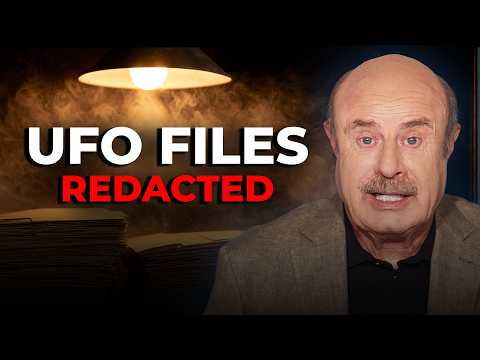
In mid-October 2026, Congressman Eric Burlison of Missouri spoke on Dr. Phil's podcast and said plainly: much about unidentified anomalous phenomena has already been disclosed, but the key questions still remain unanswered. If even members of Congress do not receive full access to the information, then who has the right to it? Burlison, one of the most active advocates of transparency in the American parliament, pointed to a specific problem — the missing documents of recent government programs.
To understand what is being discussed, one must briefly recall the background. In the late 2000s and early 2010s, the US Department of Defense and the Defense Intelligence Agency (DIA) launched several related projects. AAWSAP — the Advanced Aerospace Weapon System Applications Program — was a DIA program that studied advanced aerospace technologies, possible threats, and unusual phenomena in the air. Its contractor was Robert Bigelow's company. Later came AATIP — the Advanced Aerospace Threat Identification Program. It is often described as a continuation or a parallel effort. It was worked on, in particular, by Jay Stratton and Luis Elizondo. Both programs collected data on unidentified objects, analyzed testimony from military pilots, and sought explanations for phenomena that did not fit known physics.
In an interview, Burlison stated that the AATIP documents connected to the work of Stratton and Elizondo had either disappeared or been deleted. This concerns not the archives of the 1950s but materials from the 2010s. "Our government still blocks the president's access to information, and the best proof of that is that we cannot find the missing AATIP documents," the congressman said. He called on the administration to act more forcefully, otherwise the agencies responsible for keeping them will continue to conceal these records or simply not look for them.
Almost simultaneously, an important event occurred. On 6 October, journalist George Knapp reported that the DIA had finally located the missing AAWSAP files. On 13 October, he clarified: the documents themselves have not yet been published. James Lacatski's books compress roughly 70 thousand pages of field notes into 1250 pages of core information, while the most sensitive data remain classified. It is not yet clear whether the materials found include precisely the records Burlison spoke about. Congress and the public have not yet obtained full access to them.
In those same days, statements by Jay Stratton himself entered the public space. In a book and an interview, he recounted that while working on AAWSAP, researchers encountered the existence of a so-called "Legacy Program." According to him, it is a long-standing hidden structure involving the Air Force, the CIA, the Department of Energy, and defense contractors. Its task is to recover and study craft of unidentified origin and to engage in their reverse engineering. Stratton describes it as a program that existed for decades in parallel with official investigations and was carefully concealed even from part of the leadership.
The events line up into a single thread. First, a sitting congressman's alarm about the missing records of recent investigations. Then, a report that the AAWSAP files have been found but remain closed. And at the same time, testimony from a man who worked inside these structures about the existence of an even deeper "Legacy Program." All of this unfolds against the backdrop of efforts to declassify, when even the highest level of power encounters obstacles.
Materials that long remained in the shadows are gradually coming to the surface. The missing documents, found but unpublished, and direct indications of hidden reverse-engineering programs add up to a picture that can no longer be dismissed as speculation. Congress, journalists, and former participants continue to demand full accountability. What was kept secret for decades is ever closer to becoming public knowledge.


