


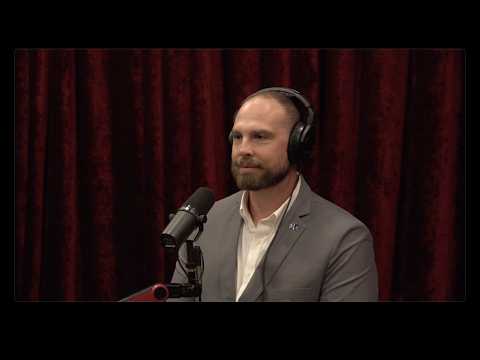
On 30 September 2026, David Grusch appeared again on Joe Rogan's podcast. The former U.S. Air Force intelligence officer, who had previously represented the National Reconnaissance Office on the task force for unidentified aerial phenomena, spoke with particular detail this time. The conversation lasted more than two and a half hours and yielded details that had previously remained outside his public statements.
Grusch said he had seen modern, high-quality video recordings from debris recovery sites. The footage shows three or four bodies. He describes them as "very, very beautiful": pale bluish-white skin, long silvery-gray hair, a statuette-like figure, and features in which it is difficult to determine sex. Nearby were tightly fitting suits and craft shaped like a crescent or a boomerang. It is precisely such images, he says, that General William McCasland had in mind when he advised Tom DeLonge to "think about Greek gods."
Other beings also appear in his sources' accounts. Reptilian ones, over seven feet tall, with scaly skin, associated with craft shaped like a "Tic Tac." At one of the recovery sites, according to these accounts, there were remains of both "Grays" and reptilians. To Grusch, this looks not like an accidental catastrophe but like the trace of a clash between different forms of nonhuman intelligence. He speaks of conflicts that the program recorded over the course of decades, and of the fact that in certain cases "we shot down the reptilians."
The theme of disclosure runs as a separate thread. Grusch believes that a significant portion of the information may become available before the end of the current presidential term. Rogan recalled a brief encounter with Stephen Miller at a UFC event at the White House: Miller said at the time that "the UFO thing is going to come out." Grusch takes this as confirmation of a serious impulse within the administration. At the same time, he cautiously notes a possible risk: in closed assessments of past years there was the idea that too abrupt a disclosure could provoke a response from a "third party" — something he compared to a "Ghostbusters moment."
Avi Loeb, an astrophysicist at Harvard and chair of the Scientific Advisory Board on UAP, reacted quickly and with restraint. He thanked Grusch for his efforts in advancing transparency and noted the board's readiness to scientifically study any evidence that emerges. "The best way forward is to bring the evidence into the light and turn disclosure into knowledge," he wrote, separately emphasizing the role of the White House and Stephen Miller.
All of this sounds like a story that until recently seemed too strange. Now it comes from a man with confirmed access to classified materials and continues to accumulate new details. The question is no longer only whether this evidence exists, but how quickly and in what form it will become available for genuine scientific study.


