



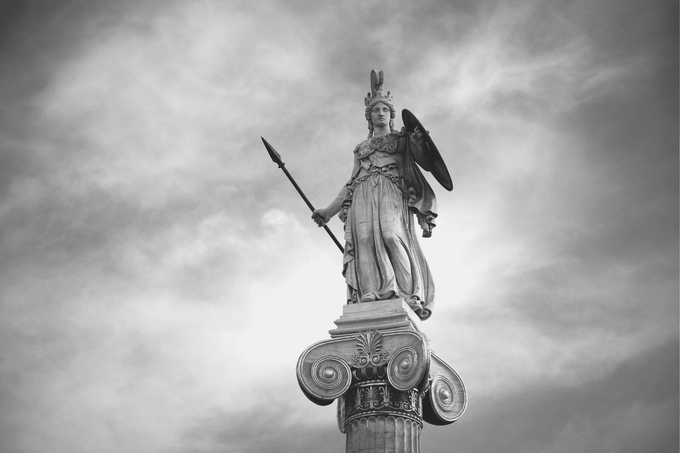
In southern Italy, among the ruins of an ancient Lucanian settlement, archaeologists found a short inscription that seems to bridge the centuries: ASANAS — the Doric form of the name of the goddess Athena. This find at Caselle in Pittari, near the Gulf of Policastro, does not merely add another name to the pantheon; it prompts us to reflect on how closely the Greek and Italic worlds were intertwined long before Roman rule.
Excavations have been conducted here since 2014 by the Laboratory of Classical Archaeology of the University of Salerno under the direction of Antonia Serritella. The inscription was discovered among an entire collection of texts that together name eight deities, including Ceres, Jupiter and nymphs associated with rain and springs. The sanctuary was situated on two terraces and, judging by all appearances, served as a place of ritual where local inhabitants brought offerings in clearly designated zones.
The Doric dialect in which the goddess's name is written was widespread in the Peloponnese, on Crete and in the Greek colonies of southern Italy and Sicily — that very Magna Graecia. Unlike Attic, it sounded different, and it is precisely this form that points to the direct influence of Greek settlers, rather than mere borrowing. Nearby, in ancient Velia, traces of a sanctuary of Athena with weapons, helmets and hundreds of votive objects are already known, which confirms the persistence of her cult in the region.
What gives the find particular value is its context: the inscriptions were found not in random places but in clearly ritual zones. This allows scholars to correlate the texts with the space of worship and to better understand how local Italic communities adapted foreign deities. Many of the gods mentioned were previously known mainly from the bronze tablet from Agnone — an important document of Italic religious traditions.
The settlement at Caselle developed from the middle of the fourth century BCE and existed until the end of the third century BCE, when it was abandoned. At that time southern Italy was a mosaic of cultures: Lucanians, Greeks, Etruscans and other peoples exchanged not only goods but also beliefs. The inscription ASANAS shows that the Greek Athena — goddess of wisdom and war — found worshippers here among those who lived far from Hellas.
Such discoveries remind us that ancient sanctuaries are not frozen museums but living testimonies of dialogue between peoples. They teach us to see in the past not only conflicts but also the mutual enrichment of ideas, languages and rituals that shaped the face of the Mediterranean.
A single short inscription can change our understanding of how deeply Greek culture penetrated the everyday life of pre-Roman Italy — one need only read the stones attentively.


