


In the boundless expanses of space, 7500 light-years from Earth, within a giant star-forming region — the Carina Nebula — an astonishing structure lies hidden. Two powerful NASA telescopes — Hubble and James Webb — have recently captured it in detail, opening a new view of star birth. This elongated pillar of dust resembles the silhouette of a cat sitting with its back to the viewer, its head turned to the right, and a bright "eye" gleaming through the darkness.
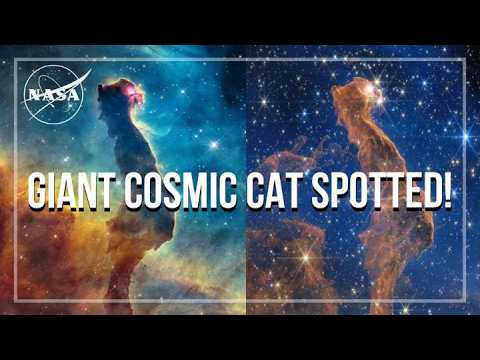
The shape of this "cat's head" is no accident. It was carved by intense ultraviolet radiation and stellar winds from massive neighboring luminaries. Dense dust and gas resist destruction, creating a temporary yet striking relief. In time the structure will disperse, but for now it holds the keys to understanding the complex processes taking place in stellar nurseries.
In visible light, Hubble shows a dark, opaque pillar of dust in a rich brown hue. Along its right edge runs a glowing yellow ridge — gas ionized by ultraviolet light from nearby massive stars. This process, known as photoevaporation, is gradually "eating away" at the material. The cat's reddish "eye" probably belongs to a young star still partly hidden in the dust. The surrounding regions shimmer from blue and turquoise at the top to yellow, orange and red at the bottom — the light of oxygen, hydrogen, sulfur and scattered starlight.
Webb, in the near-infrared, penetrates through the dust. The pillar becomes semi-transparent, revealing the complex texture of its surface. Dozens and hundreds of stars appear — blue and yellow points, some of them still wrapped in dust. The same "eye" glows bright yellow. Even distant galaxies emerge in the background, like a window into an even deeper cosmos. To the left of the main structure, ghostly filaments of dust and gas are visible, softly lit by radiation from neighboring stars.
In the mid-infrared, the picture changes once again. Warm dust and carbon-bearing molecules excited by starlight bring out the finest details: globules, filaments, intricate patterns. A bright source to the right of the pillar — probably another young star immersed in dust — shines against the reddish glow of the surrounding matter.
These three views — visible, near- and mid-infrared — come together into a single story. They show how the energy of massive stars shapes space, how new luminaries are born in dense clumps, how matter is constantly rearranged. The Carina Nebula is one of the most active star-forming regions in our Galaxy, and this small patch within it demonstrates processes that go on everywhere.
Look at these images more closely. Within a single slender pillar of dust lies an entire world: birth, resistance, destruction and renewal. Everything is connected: the radiation of distant stars carves out shapes that in millions of years will become new systems, perhaps with planets. The cosmos is arranged with astonishing precision and at the same time chaotically. We live in a world where, at a distance of thousands of light-years, events of such grandeur unfold that even the most powerful telescope only lifts the veil a little. And each new image reminds us: the universe is infinitely complex, beautiful and full of mysteries still waiting to be solved.


