


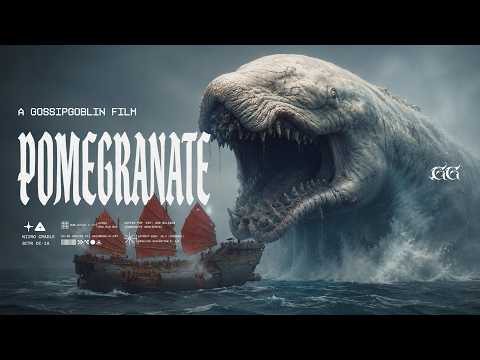
On July 22, 2026, an author working under the pseudonym Gossip Goblin released the science fiction short film 'Pomegranate'. Behind this unusual project is director and screenwriter Zach London, creator of a dark futuristic universe where technology fulfills almost any human desire but cannot guarantee happiness.
From the very first frames, 'Pomegranate' grabs attention with its high-quality visuals, created using generative neural networks. However, this is not just a collection of spectacular scenes randomly strung together based on beautiful prompts. The film is built upon a full-fledged authorial script, thoughtful dramaturgy, editing, voice acting, music, and professional sound design.
Zach London served as director, screenwriter, and one of the film's producers. A separate team of artists worked on the animation and visual design, and professional actors voiced the characters, including Sam Dale, Ben Kersley, Oscar Merry, and Aycha Ozkan. Ann-Sophie Versnaeyen and Juan Toran composed the original music, while Marian Balan handled the sound design.
The Ageless Man Bored by Wonders
The protagonist of 'Pomegranate' is a wealthy aristocrat of the future who has already lived more than one ordinary human life.
Over long centuries, he has experienced wars, enjoyed luxury, changed numerous partners, and felt almost everything civilization has to offer. He loves women, pleasures, and beautiful stories, but gradually even the strongest impressions cease to move him.
In the film's world, memories, fantasies, and entire lives can be purchased much like movies or computer games are bought today. Therefore, the jaded immortal seeks out a seller of artificial dreams, hoping to find at least one experience that feels real again.
The film's official description articulates its internal conflict precisely: after centuries of simulated wars, wives, and wonders, the protagonist seeks anything that can still be felt as real.
At first glance, this is a story about future technologies. But in reality, 'Pomegranate' is a film about feelings, wars, love, memory, and the fatigue of immortality.
What remains of a person if they gain the ability to experience everything? Can strong emotions be repeated endlessly without diminishing their value? And can the soul contain an infinite number of wonders?
One of the film's key ideas sounds almost like a warning:
'The soul can only hold a limited number of wonders.'
The more incredible things the protagonist experiences, the harder it becomes for him to feel genuine admiration. A wonder that can be ordered ceases to be a wonder.
Not a 'One-Button Movie'
The working process chosen by Zach London is particularly interesting. The author deliberately did not hand over production entirely to automatic video generators.
First, static images of characters, costumes, and environments were created in Midjourney. Personalized settings and style references were used to maintain a consistent appearance for the characters and a recognizable dark aesthetic.
Then, the frames were manually edited, cleaned, and composited using generative editing tools, including Nano Banana. This stage effectively replaced traditional Photoshop work.
Only after the composition was approved were the static images turned into video using the first-frame image-to-video method — animation based on a pre-prepared first frame. Models like Kling and similar tools were used for this.
This approach requires significantly more manual labor than generating a complete scene with 'one click,' but it allows for control over composition, camera movement, facial expressions, and frame sequencing.
AI here does not replace the director. It becomes part of the production toolkit, like a camera, editing software, or graphics editor.
Zach London himself emphasizes that for him, the story and the world-building remain paramount, and artificial intelligence is a practical way to realize a concept that would be too expensive or unusual with traditional production.
The Image is AI-Generated, But the Sound Remains Human
A fundamentally important feature of 'Pomegranate' is that its sound part is created by humans.
Characters are voiced by professional live actors. Music is composed by composers, and steps, rustles, impacts, clothing movements, and the sounds of futuristic interfaces are created and processed by sound designers and Foley artists.
The same approach is used in London's upcoming feature film project, 'Gods Don't Give Gifts'. The creators consciously avoid replacing actors' voices and music with artificial generation, considering human sound to be a crucial part of the emotional connection with the viewer.
Perhaps this is why, when watching 'Pomegranate,' one doesn't get a complete sense of artificiality.
Where Does the Author End and the Machine Begin?
While watching, the mind genuinely tries to find evidence that this is 'fake' cinema.
Periodically, the thought arises: soon, emptiness, emotional falseness, or the absence of something subtly human will be revealed.
But the film does not leave one with a sense of emptiness.
Instead, another question arises: how much of what is seen belongs to the author, and how much belongs to artificial intelligence?
Where does Zach London's script end and the neural network's independent interpretation begin? How accurately does the machine execute the human vision? Can the film be considered authorial if a significant portion of the visuals is synthesized by algorithms?
'Pomegranate' doesn't provide a definitive answer but prompts reflection on these questions throughout the viewing.
And perhaps, this is already a significant achievement. If the viewer contemplates the story's meaning, worries about the protagonist, and thinks about the value of their own life, then the film is working—regardless of the tool used to create its visuals.
The Value of Life as the Ability to Feel
Visually, 'Pomegranate' is truly impressive. We are presented with a beautiful, dark, and meticulously constructed cyberpunk world. It conveys a scale that, until recently, would have required a massive budget, sets, and complex computer graphics.
But the film's main merit is not its technology.
Behind the striking visuals lies a profound philosophical theme: the value of life lies not only in the quantity of experienced events but also in the ability to feel them.
One can live for hundreds of years, participate in wars, love many women, see the most incredible places—and still lose the feeling of being alive.
Alternatively, one can experience a single genuine feeling that proves more important than a thousand artificially created wonders.
Prologue to a Grand Film
'Pomegranate' served as a preview for Zach London's first feature film, 'Gods Don't Give Gifts'.
This is a science fiction anthology of four stories, united by a single universe. The narrative unfolds in a future where humans can enhance their bodies, buy and sell memories, transfer consciousness, and overcome conventional biological limitations. However, each new capability comes at a certain human cost for the characters.
Limited theatrical release in American cinemas is planned for October 30, 2026. Among the proposed screening cities are New York, Los Angeles, San Francisco, and Chicago. The project, created in collaboration with Fable Studio, aims to show whether the internet audience is ready to watch authorial cinema with AI visuals not just on YouTube but also on the big screen.
Gaya's Rating — 8.9 out of 10
For a short film whose visual part was created with artificial intelligence, 'Pomegranate' makes an unexpectedly strong impression.
These are quite new and interesting sensations. You simultaneously follow the plot and observe yourself: trying to understand if you perceive the events as a complete film or still treat it as a technological experiment.
The high-quality visuals, expressive sound, unusual protagonist, and philosophical theme make 'Pomegranate' much more than just a demonstration of neural network capabilities.
Gaya's Rating — 8.9/10.
This film does not yet definitively erase the line between traditional and AI-created cinema. But it shows that within generated imagery, authorial thought, atmosphere, and genuine feeling can certainly exist.
After all, what matters to the viewer is not the tool used to draw the frame.
Something else is far more important: did that frame manage to make us feel something?
'Pomegranate' succeeded.


