


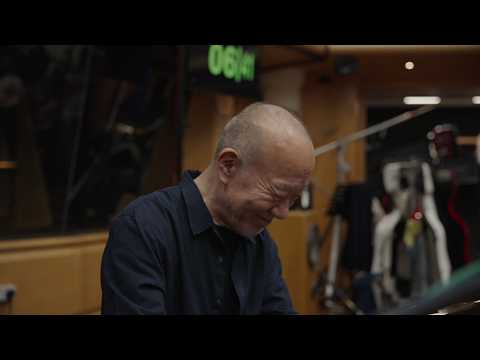
Today, August 17, 2026, marks the conclusion of Japanese composer Joe Hisaishi's seven-day residency at New York's legendary Radio City Music Hall.
From August 11 to 17, Hisaishi conducts the Orchestra of St. Luke’s, performs on piano, and collaborates with the MasterVoices choir. The program features music from Studio Ghibli films, as well as scores composed by him for works by Hayao Miyazaki, Takeshi Kitano, and Isao Takahata.
However, these concerts are more than just a musical event. They are a space one can enter.
When the Hall Becomes Part of the Music
In January 2026, the Sphere Immersive Sound system became available for all concerts and events at Radio City Music Hall.
It employs technologies for three-dimensional beamforming and wave field synthesis. Over 7,000 individually amplified acoustic drivers help maintain uniform volume and sound clarity—from the first rows of the orchestra to the last line of the third balcony.
The system also allows sound engineers to spatially position individual sounds and direct them to different points in the hall. This alters the traditional geometry of perception.
While the orchestra remains on stage, the music is no longer confined to a single source. The piano, choir, and orchestral voices can form a unified soundscape that envelops the listener.
Space ceases to be merely a vessel for music; it becomes its instrument.
And the listener is no longer an outside observer. Their body, breath, and memory become integral to the perception of the work: music sounds around them and simultaneously resonates within.
A Melody Gifted to a Friend
In parallel with his New York residency, a new chapter is beginning in Hisaishi's creative work.
On November 6, 2026, the album The Boy and the Heron: Symphonic Suite will be released—a symphonic reimagining of the music from Hayao Miyazaki's film “The Boy and the Heron.”
The first single is ASK ME WHY.
The story of this theme began with a personal musical gift. Hisaishi composed a short piano melody for Hayao Miyazaki's birthday. It so moved the director that it later became one of the central themes of the film.
In April 2025, Hisaishi recorded a new symphonic version with the Royal Philharmonic Orchestra. The intimate piano idea unfolded into an independent work for solo piano and orchestra. This is no longer merely an expansion of the soundtrack.
The music transcends cinematic narrative and begins to tell its own story.
Forty Years of Shared Sound
Hisaishi and Miyazaki's creative partnership began over forty years ago—with the film “Nausicaä of the Valley of the Wind,” released in 1984.
Since then, Hisaishi's music has become inseparable from Miyazaki's worlds.
While working on “The Boy and the Heron,” the director granted the composer unusually broad freedom. Unlike previous projects, Hisaishi did not receive the usual amount of preliminary material: he was to see the finished film and independently hear its inner musical world. This is how a space for true co-creation emerges.
One artist does not explain to another what they should feel.
They trust them to listen.
The Question That Moves the World
Ask Me Why translates to 'Ask me why.'
But the question remains without a direct answer.
Why do we come into this world?
Why do we meet those we love?
Why do we experience loss?
Why do we continue our journey?
Hisaishi does not answer with words. He allows the question to pass through the piano, spread through orchestral voices, and return to the listener not as a thought, but as a sensation.
In the film, this melody accompanies Mahito's inner journey—through loss, uncertainty, and an encounter with a world existing beyond the boundaries of familiar reality.
A single musical gift becomes part of a film. The film transforms into a symphony.
And a personal conversation between two masters begins to resonate for the entire world.
How Minimalism Reveals Space
At the heart of the symphonic suite lies Hisaishi's characteristic minimalist language: repeating musical patterns and short phrases that gradually transform through new orchestration. The piano articulates an idea.
The orchestra picks it up, reflects it, and carries it into new sonic dimensions.
The music does not rush to provide an answer. It moves between silence and sound, solitude and the fullness of the orchestral field.
Each repetition is not a return to the starting point, but a subsequent layer of perception. The same melody sounds different because the space around it has changed.
And we ourselves have changed.
How Does Space Begin to Resonate?
In these days, Hisaishi's music undergoes several expansions simultaneously.
From a personal gift—to a film.
From screen music—to a symphonic suite.
From the stage—to the entire volume of the concert hall.
From a heard melody—to the inner world of a person.
The New York residency and the upcoming release of the new album wonderfully echo each other.
In one event, music transcends the stage and becomes space.
In the other, an intimate melody unfolds into a full orchestral sound.
And then the question arises: where does the work end?
At the last note?
Within the walls of the concert hall?
In the memory of the person who carries the music with them?
Music continues to alter the inner landscape even after the orchestra falls silent. It remains in the body, breath, and perception, connecting with a person's personal history—and through them, returns to the world.
Space begins to resonate not only when thousands of acoustic drivers fill it.
It begins to resonate when one hears not individual notes, but the whole—and enters into resonance with it.
We ask a question.
Music opens a space for an answer.
And space continues to resonate through us.


