


What happens when a song is sung in a language that does not exist—yet we still feel what it is saying to us?
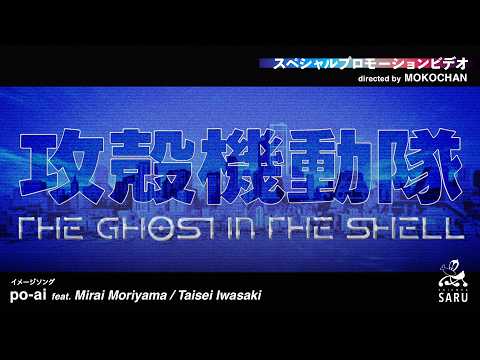
For the new anime series THE GHOST IN THE SHELL composer Taisei Iwasaki created the theme composition po-ai feat. Mirai Moriyama. Its lyrics cannot be found in any dictionary: they are written in a specially invented language born from the interaction between human and artificial intelligence.
But the music seems to need no translation.
Voice, breath, and movement convey meaning before the mind even has time to ask: "What is this song about?"
A language created in dialogue with AI
A special music video was presented on August 19, 2026. It was directed by the director of the new adaptation MOKOCHAN.
The lyrics, music, and arrangement were written by Taisei Iwasaki —one of the project's music directors. The vocal part was performed by the Japanese actor and dancer Mirai Moriyama.
According to the creators, Iwasaki developed a fictional language in collaboration with several artificial intelligence systems, and then translated the written text into it.
AI does not replace the author here. It becomes a tool that allows for exploring combinations of sounds and meanings that have never existed before. But the real transformation begins later.
When the invented language passes through a human voice, it ceases to be a collection of unfamiliar syllables. Intonation, timbre, breath, and pauses imbue it with emotional life.
Technology opens up the possibility. A human turns it into an experience.
Is it possible to hear meaning without translation?
We are accustomed to thinking that we must first understand the words and only then feel their meaning.
Music shows otherwise.
Even before the consciousness begins to decipher the text, the body already recognizes tension and release, closeness and distance, tenderness, anxiety, and a call.
We are not always able to explain what we hear, but we already respond to it with our breath, heart rate, and internal movement.
Perhaps meaning exists not only within words. It is born in the relationship between sound and silence, voice and listener, impulse and response.
Music speaks the language of resonance—a language that requires no translation.
The fictional speech becomes not an obstacle, but an invitation to stop searching for familiar definitions and allow perception to become deeper and more sensitive.
The human within technology
Such an experiment is especially symbolic for the world of Ghost in the Shell.
For decades, this story has explored the boundary between human and machine, body and consciousness, memory and program. If technology is capable of altering the body and expanding the mind, where does the created system end and the living 'self' begin?
The composition Po-ai transfers this question into music.
Artificial intelligence participates in its creation. It sounds in a language that belongs to no human culture. Yet it only comes alive when it passes through the performer's body and meets the listener's perception.
The result is an unusual sequence:
- A human creates the intention.
- AI helps discover an unknown language.
- The voice fills it with feeling.
- The listener's body recognizes the meaning.
The boundary between the human and the technological ceases to be a wall. It becomes a meeting place.
Not to create a new form, but to change perception
Perhaps the main discovery of this song lies not in the invention of a language.
We do not always need to create a new form to hear the unknown. Sometimes it is enough to change our own perception—and discern what has always been sounding, but previously remained beyond our attention.
The ocean, too, does not speak in human words.
It speaks through the movement of water, depth, tides, the voices of whales, and the pauses between waves. We can translate its signals into graphs and data, but true recognition sometimes happens before explanation—in the body, intuition, and memory. This is how music is born.
We do not decipher it—we enter into resonance with it.
As if different points in space simultaneously caught the same wave. The world is searching for a language capable of connecting without translation: human with ocean, technology with consciousness, the unknown with internal recognition.
What has this added to the sound of the planet?
Po-ai reminds us: understanding does not always begin with words.
Sometimes the body hears first. Then feeling responds. And only after that does consciousness attempt to name what has already occurred.
Perhaps the language of the future will not need to be learned.
Perhaps it will need to be remembered—to return to that part of oneself that has always known how to listen.


