


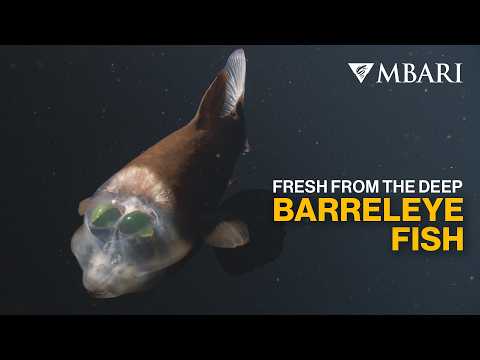
A small fish with a transparent dome of a head appears in the water column. Inside, two green structures are visible — its eyes. They are directed upward, toward where the faint light still comes from. Before us is the barreleye — a living reminder of how many ways of seeing exist on a single planet.
28 October 2026 The Monterey Bay Aquarium Research Institute — MBARI — presented new footage of Macropinna microstoma. The fish was encountered at a depth of about 600 meters, during the October expedition of the research vessel David Packard.
For the institute, this was only the eleventh observation of the barreleye in nearly forty years of research, and the first time it was captured in 4K. MBARI's previous encounter with this species occurred in 2021.
An Encounter Worth Stopping the Ascent For
The submersible Doc Ricketts was already returning to the surface after a day's work. Most of the science team had moved to the laboratory, preparing to sort through the collected samples.
It was then that the specialist Shannon Johnson spotted the barreleye and asked for the vehicle to be stopped.
Soon researchers and crew members gathered at the screens. The chance encounter allowed them to observe the rare visitor for about twenty minutes, studying her movements and the transparent head shield. The team changed the lighting, and the pilot Cameron Lowe was able to bring the vehicle close enough for stereoscopic filming with a VR camera. The fish was not caught — it remained in its own environment.
Where are its eyes?
A first look at the barreleye is easily misleading. The real eyes are located inside the transparent dome: they are large tubular structures with a noticeable green coloration.
This arrangement is connected to life in the ocean's twilight zone. Here sunlight is already very faint, and a barely discernible silhouette overhead may prove to be an important clue.
The barreleye is able to hold itself in the water almost motionless thanks to its large fins. Its eyes are directed upward, allowing it to survey the space above. When it shifts to capturing food, they rotate beneath the transparent shield, keeping the object in its field of view. These behavioral features became clearer thanks to earlier observations by MBARI researchers.
The result is a remarkably precise system: a stable body position, mobile eyes and transparent tissue working in concert.
Transparency as protection
The head dome is living tissue, not solid glass. It surrounds the sensitive visual apparatus.
According to MBARI's explanation, this shield also protects the eyes when the barreleye takes small crustaceans that have ended up in the capturing tentacles of siphonophores — colonial relatives of jellyfish. Transparency here therefore has a thoroughly practical meaning: it allows it to see and at the same time creates a protective barrier.
In one small fish are combined features that would be hard to invent relying only on the terrestrial world familiar to us.
Seeing beauty through another gaze
The barreleye lives in conditions where our eyes would quickly lose their bearings. For it, this depth is filled with distinctions: light, silhouettes, movement, the possibility of finding food.
The ocean invites us to expand our own gaze. The world becomes richer when we learn how differently it is perceived by other forms of life.
Each has its own way of being present in the shared space. Understanding these differences allows us to feel our connection with the living planet more attentively.
Beauty is already here — in the transparent dome, the smooth movement of the fins, the green eyes turned toward the light. Our attention makes an encounter with it possible. And with this encounter, the familiar world comes to contain more visible wonder.


