



Pioneering research conducted by Project CETI has recently demonstrated that sperm whale vocalizations contain structural elements that are remarkably similar to the vowels used in human speech. This discovery marks a significant shift in our understanding of marine biology, suggesting that the sounds of the deep are far more organized than previously believed.
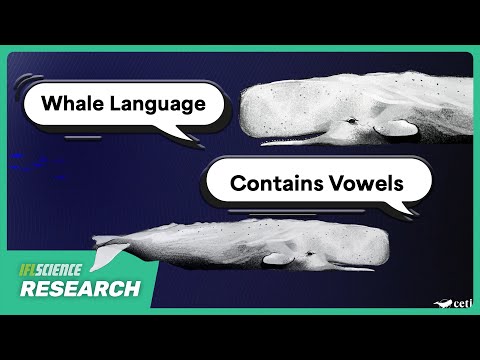
The study is based on a comprehensive acoustic analysis of thousands of recordings gathered near the island of Dominica. This specific location is one of the few places on Earth where sperm whales live in stable matriarchal communities and regularly participate in complex acoustic interactions with one another.
For the first time, it has become evident that the ocean is not just a place of sound, but a place of active conversation. These findings suggest that these massive mammals are engaged in a form of dialogue that mirrors the complexity of human social structures.
Researchers discovered that the rhythmic sequences of clicks, known as sperm whale codas, are not organized by chance. Instead, they follow a sophisticated internal logic that allows for the transmission of specific information within the group.
Within these codas, the research team identified two distinct and stable categories of signals, which they have classified as a-type and i-type sounds. These categories serve as the foundational building blocks for their entire communication system.
While these are not literal vowels in the human sense, they represent phonological categories. This is the same level of linguistic structure upon which all human languages are built, indicating a shared fundamental approach to communication.
Furthermore, the study revealed that the duration of these clicks is essential for conveying meaning. By varying the length of the sounds, the whales can change the intent and content of their messages.
This suggests that sperm whales utilize a temporal architecture of sound as a primary carrier of information. The precise timing and arrangement of these clicks allow for a highly nuanced and adaptable form of expression.
Until now, it was widely assumed that such complex linguistic organization was a unique feature of the human species. This new data challenges that assumption, proving that other creatures have developed their own sophisticated systems.
We now know that sperm whale communication involves rhythm, variations in duration, specific sound categories, and repeating structures. These elements combine to form a system that is far more advanced than simple signaling.
This is a complete communication system that has emerged independently of human speech. From an evolutionary perspective, humans and sperm whales have been separated for approximately 90 million years, making the similarities even more astounding.
Unlike the songs of humpback whales, which often follow musical patterns, sperm whale codas function quite differently. They are not performances but are instead used for direct and functional interaction between individuals.
These codas sound like an exchange of ideas, functioning as remarks, responses, and a way to coordinate activities within the pod. This interactive nature is what led Project CETI researchers to view them as a non-human language system.
To analyze these complex sounds, the team employed advanced machine learning and artificial intelligence. These technologies were crucial in identifying patterns that would be impossible for humans to detect through traditional observation.
The AI helped reveal several key patterns, including the spectral structure of the sounds and the variations in click intervals. It also provided insight into the context in which these sequences are used, further proving their linguistic nature.
This is the first time that the acoustic system of sperm whales has been investigated at a phonological level. By focusing on the underlying structure, scientists are beginning to treat whale communication as a legitimate language.
The importance of this discovery today is immense, as we are approaching the boundary of translating non-human speech. This is no longer a metaphorical goal but a scientific possibility that could change our world.
For the first time in human history, we may have the opportunity to understand what the ocean says about itself. This could lead to a new era of conservation and a deeper respect for the intelligence of marine life.
This event has added a new layer to the sounds of our planet, proving that language is not a human monopoly. It shows that culture and complex social systems can exist in the deep ocean, far removed from our own.
We are finally starting to hear the signs of another intelligent social system on Earth. Humanity has long considered itself the only voice of the planet, but it is now clear that we have always lived among other speaking worlds.
- It has been demonstrated that complex language can emerge outside of the human species.
- It has been proven that sophisticated culture can thrive in the depths of the ocean.
The realization that we are not the only communicative species on Earth is profound. It forces us to reconsider our place in the natural world and how we interact with other sentient beings.
For centuries, we viewed ourselves as the sole narrators of the world's story. However, the research from Project CETI suggests that we have always shared the Earth with other articulate and communicative civilizations.
Ultimately, it is becoming clear that we live in a world filled with diverse speaking worlds. Acknowledging these voices is the first step toward a deeper, more respectful connection with the intelligent life that surrounds us.
As science continues to peel back the layers of whale communication, the line between human and non-human intelligence blurs. We are entering an era where the silence of the sea is being replaced by a chorus of ancient voices.
This journey into the linguistic world of the sperm whale is just beginning. With each new discovery, we move closer to a universal understanding of what it means to communicate and exist on this planet.


