


World Models: How AI is moving from screens into real-world systems. Why the top 10 technologies of Davos 2026 will redefine competitive advantage by 2030.
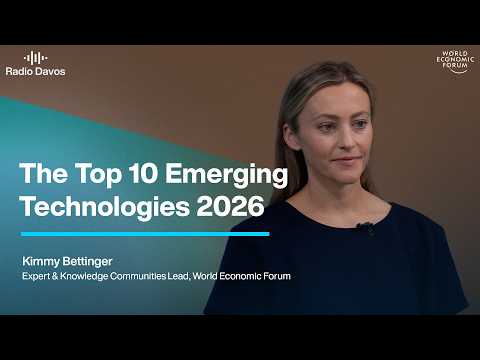
At the 2026 Summer Davos, held from June 23 to 25 in Dalian, the World Economic Forum, together with Frontiers and the Dubai Future Foundation, presented the "Top 10 Emerging Technologies of 2026" report.
Among the ten selected innovations are world models: AI systems that, instead of predicting the next word, learn to forecast the next state of physical reality. This is not merely a software breakthrough. It signals a fundamental turning point: after a decade of investment in text-based AI, the industry is finally moving beyond screens and into the material world—power grids, manufacturing, and healthcare.
Why are these two specific technologies—world models and lattice-based cryptography—paired together in this list? It is because they reflect a new logic of global competition. On one hand, after years of investing in text-based AI, capital and regulators are seeking technologies with direct impact—those that act upon real-world systems. On the other hand, as the forum's host, China is promoting sectors where supply chains are already established, from lithium extraction to biotechnological solutions.
The report was released at a critical juncture as global supply chains recover from the pandemic and energy crisis, viewing predictive systems as a vital tool for managing uncertainty.
The full top 10 includes technologies for energy (everything-to-grid bidirectional power exchange; water-efficient direct lithium extraction), materials science (passive radiative cooling), and pharmaceuticals (personalized mRNA cancer vaccines, exosome-based drug delivery, and quantum modeling for drug development). It also covers recycling (the degradation of PFAS "forever chemicals"), biomanufacturing (precision microbial fermentation), and data security (lattice-based cryptography). Each of these technologies is on the threshold of mass adoption, with experts predicting commercial scaling within three to five years.
How do world models work? They function differently than traditional language models. Instead of predicting the next word, they learn to forecast the next state of a physical system, understanding spatial relationships, physical laws, and real-world cause-and-effect. They are trained on video data and simulations. This unlocks possibilities for autonomous vehicles, robotics, and the precise modeling of complex industrial and climate processes.
By 2026, the first commercial systems are already being deployed: Google DeepMind has released Genie 3, NVIDIA launched Cosmos, Alibaba introduced Happy Oyster, and Yann LeCun’s company (AMI Labs) raised $1.03 billion for the development of these specific models.
Lattice-based cryptography is no accidental partner on this list. World models will contain critical data regarding development scenarios for the economy, energy, and supply chains. This makes them an ideal target for hackers and state actors. Without quantum-resistant protection, such systems will be vulnerable the moment powerful quantum computers are developed.
Lattice-based cryptography protects data through complex mathematical structures that ensure resistance against both classical and quantum attacks. Apple is already integrating such cryptography into iMessage, and Google plans to include it in Android. The benefits of this integration primarily accrue to governments and large corporations investing in sovereign AI platforms.
Commercial deployment is already beginning. In energy and pharmaceuticals, the return on investment from accurate prediction is measured in months, not years. Countries and companies that integrate predictive models into real-world power grid and manufacturing management systems ahead of others will gain a competitive advantage in costs and response times. The logic is simple: those who control predictions regarding the future state of systems effectively control their optimization today.
There are also counterarguments to consider. Regulatory barriers regarding the use of personal data could slow adoption in medicine by one to two years. If quantum computers appear sooner than expected, world models without lattice-based cryptographic protection will be left vulnerable. Both scenarios are realistic, yet they do not negate the underlying trend—they only shift its timing.


