



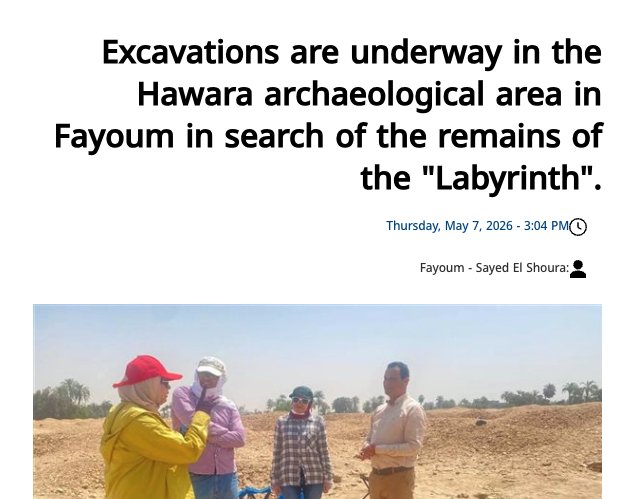
In early May 2026, archaeologists in Egypt's Faiyum Oasis reached a milestone decades in the making. Near the Pyramid of Amenemhat III, at the heart of the suspected ancient complex, a massive megalithic wall emerged from beneath the sand. These colossal blocks represent the first tangible physical contact with a structure that ancient chroniclers regarded as one of humanity's most magnificent achievements—the legendary Labyrinth of Hawara.
Here it is folks - THE VERY FIRST VIEW of the ACTUAL Labyrinth of Egypt!!!!!!! Mission Hawara is on! We're witnessing the very beginning of the project that will recover our real history. Tim Akers, who carried out the most advanced subterranean scans of the structure, described


Writing in the 5th century BCE, Herodotus described it as a structure that surpassed even the pyramids, featuring thousands of rooms, intricate corridors, multi-level halls, temples dedicated to every Egyptian deity, and statues and artworks "beyond description." For many researchers, this was more than just a royal tomb; it was a vast repository of knowledge, an ancient archive or "hall of records" that might hold traces of a distant past.

For centuries, the Labyrinth remained concealed beneath desert sands and groundwater. 19th-century excavations, including those by Flinders Petrie, primarily uncovered later-period brick structures. The modern chapter began in the 2000s. Between 2007 and 2009, the Belgian Mataha Expedition, led by Louis de Cordier, and a Polish-Egyptian team conducted ground-penetrating radar and electromagnetic surveys. The results suggested extensive underground structures, shafts, and a multi-level complex beneath the pyramid. However, a canal dug back in 1820 and rising groundwater posed a serious threat of destruction.
Further scans conducted in 2014 and 2015, including work by Timothy Akers, identified galleries containing free-standing objects and potential storage chambers. These findings reinforced the concept of the complex as a true repository of ancient knowledge. By 2025–2026, a joint effort by the Archaeological Rescue Foundation, the Mataha Foundation, and their partners produced a detailed Master Plan to save the site. The project was approved, and work officially commenced.
Now, it is May 2026. In the labyrinth's central zone, the team has reached significant stone masonry. Photographs from the site show imposing blocks protruding from the sand against the backdrop of the ancient pyramid. This is no mere foundation for a later building; the evidence points to a massive and sophisticated construction that still guards its secrets.
The importance of these initial steps cannot be overstated. If the Labyrinth has indeed survived even partially, we are presented with a chance to explore one of the ancient world's most enigmatic monuments. Ahead lies the drainage process, meticulous documentation, new scans (including contributions from Filippo Biondi following his work in Giza), and the gradual unveiling of what has been buried for millennia.
This is only the start of a long journey. Yet, each new stone recovered from the Faiyum sands lends weight to the ancient legend and serves as a reminder of the depth and complexity of Egyptian history—and perhaps the civilizations that preceded it. The upcoming stages promise to provide new answers to age-old questions.


