


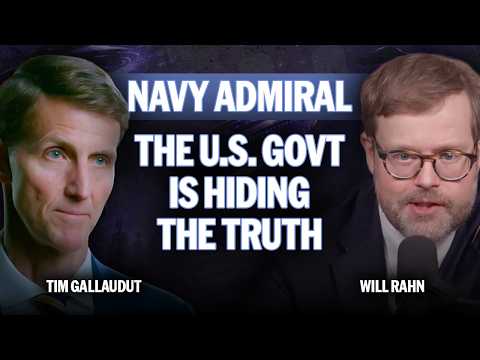
In late April 2026, a striking interview with The Free Press featured retired U.S. Navy Rear Admiral Timothy Gallaudet, whose assertions quickly ignited a firestorm across social media platforms. As a former oceanographer and the erstwhile head of the National Oceanic and Atmospheric Administration (NOAA), Gallaudet is no stranger to classified data regarding Unidentified Anomalous Phenomena (UAP). He boldly claimed that Atlantis is far from a mere mythological tale, asserting instead that it is a tangible reality supported by evidence. Furthermore, he suggested that our planet has long been under the watchful eye of a higher-order intelligence, the true nature and motives of which remain a profound mystery to humanity.
Gallaudet brings significant credibility to these discussions, having previously testified before Congress and frequently referencing the well-documented 2015 encounter involving the USS Roosevelt. He emphasized that the information currently available to the public represents only a tiny fraction of the total data collected on UAPs. According to his assessment, if the public were granted access to a thousand such recordings rather than the three widely known videos, it would trigger a monumental shift in collective awareness. He believes this sheer volume of evidence is what is necessary to fundamentally transform how society perceives our reality.
Given his extensive background in marine science, the Admiral placed a specific emphasis on the world's oceans as a primary theater for these anomalies. Gallaudet does not rule out the possibility that sophisticated bases or remnants of a higher civilization are concealed within the deep sea or other inaccessible maritime regions. These statements align with his long-standing view that encounters with the unknown are far more frequent than generally acknowledged. He predicts that the revelation of these truths will emerge as the defining narrative of the 21st century, eventually overshadowing all other global events.
The digital response to these claims was predictably polarized, ranging from those who see it as a definitive step toward government transparency to skeptics who view it as another sensationalist headline lacking concrete proof. Gallaudet, however, anchors his perspective in official observations and the unique access he maintained throughout his years of high-level service. He speaks of a superior intellect possessing technological capabilities that dwarf our own, noting that we are still struggling to determine if these entities observe us with curiosity, caution, or perhaps more enigmatic intentions.
Naturally, such provocative assertions are met with a healthy dose of skepticism, especially since the legend of Atlantis has been debated since the time of Plato and modern science demands physical artifacts for validation. Nevertheless, the professional stature of the individual making these claims—a distinguished military officer, scientist, and high-ranking government official—demands serious consideration. If even a small portion of Gallaudet’s testimony proves accurate, it suggests that humanity is on the verge of a radical re-evaluation of its status within the broader universe.
While official government bodies maintain a stance of strategic caution and much of the data remains under the veil of secrecy, figures like Gallaudet are effectively shifting the boundaries of public conversation. Whether this leads to a genuine scientific breakthrough or simply remains another chapter in an ongoing debate is a question only time can answer. However, the fundamental inquiry has been launched: if we are indeed not alone and ancient civilizations like Atlantis left behind a legacy, we may be forced to rewrite human history from its very foundations.


