


Music has always been a landscape for reimagination.
From covers and remixes to live improvisations, every generation has re-experienced familiar melodies through its own emotional lens. This week, however, that tradition crossed a new frontier.
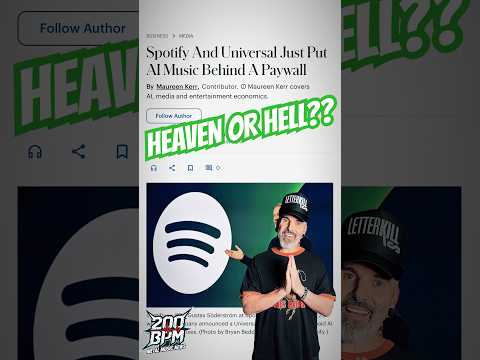
On **May 21, 2026**, Spotify and Universal Music Group announced a landmark agreement that paves the way for licensed AI-generated covers and remixes for Spotify Premium subscribers.
The core concept allows listeners to craft new versions of their favorite tracks using generative AI—not through the chaotic "gray market" of synthetic voices and pirated experiments, but within an official framework built on artist consent, royalty payments, and clear attribution.
This is more than just a new tech feature. It could represent the moment the listener evolves into a co-creator.
What happened?
Spotify announced that the new functionality is intended as a **paid add-on for Premium subscribers**. Neither a specific launch date nor pricing details have been disclosed yet.
Crucially, participation is limited to artists who **voluntarily choose to opt-in**.
Spotify is highlighting three core pillars for this new model: **consent, attribution, and compensation.**
This ensures that whenever an artist's work is used for an AI-driven interpretation, the creators and rights holders are fairly compensated.
Essentially, it is an attempt to transform the fragmented AI market into a legitimate musical ecosystem.
Why does this matter now?
Because AI-generated music is no longer just an experiment.
Over the past few months, the musical landscape has been flooded by:
— viral AI covers featuring simulated celebrity voices
— generative platforms like Suno and Udio
— legal battles over intellectual property rights
— a growing audience that wants to participate in creation rather than just listen
Spotify appears to be making a strategic move: rather than fighting the phenomenon, they are integrating it into the formal music economy. This shift has the potential to reshape the entire industry.
The fundamental question
Historically, a remix has been a human gesture. It was an act of interpretation.
A dialogue. An emotional response from one creator to another.
But what happens when an algorithm becomes the intermediary?
If a user simply enters a prompt and receives a new version of a track:
— who is the author here?
— where does human creativity end and machine generation begin?
— can artificial intelligence convey emotional authenticity?
— will music devolve into an infinitely reconfigurable construction kit?
The technology is ready. The philosophical answer, however, is not.
Industry reaction
The response to the news has been polarized.
Some see it as a new frontier of creative freedom: an opportunity for listeners to engage more deeply with music.
Others view it as a dangerous precedent: a world where the human voice is a replicable resource and uniqueness becomes a disposable commodity.
And perhaps that is exactly where the core tension of this story lies.
Because this is about more than just technology. It is a question of what music actually represents to us.
A product?
A tool?
Or is it still the living transmission of human experience?
How does this impact the world’s soundscape?
Throughout history, music has evolved alongside new instruments.
The piano transformed composition. Electricity redefined the stage. Sampling altered the very concept of authorship.
Now, artificial intelligence could change not just the form of sound, but the intimacy between music and humanity.
The next era of music may not be defined by whether machines can create sound.
Instead, it will be about whether we can still distinguish reproduction from resonance.
Perhaps the soundtrack of the future will not be written by man or machine in isolation, but by a new and still-emerging union between the two.


