


A lone violin note appears like a scratch on the surface of silence. Behind it a guitar emerges, a voice and a choir appear — and the music gradually opens a passage into a strange place that is not on modern maps.
It is a village that seems to have remained between epochs. Here ancient stones hold memory, a wedding stands next to a cemetery, and the past does not disappear — it continues to be invisibly present among the living.
Thus begins On Chapel Slope — a new composition by the British musician and producer Steven Wilson. But what is especially interesting is not only the world he created, but how he allowed that world to be born.
In an era when digital technology can align every note and remove the slightest inaccuracy, Wilson deliberately chose a different path. He left roughness, accidents and traces of human touch in the music.
A new song from a village outside of time
The composition On Chapel Slope and the official music video were released on 2 October 2026. This is the second fragment of Steven Wilson's ninth solo album Requiem for a Village, whose release is scheduled for 6 November 2026 on the Fiction Records label.
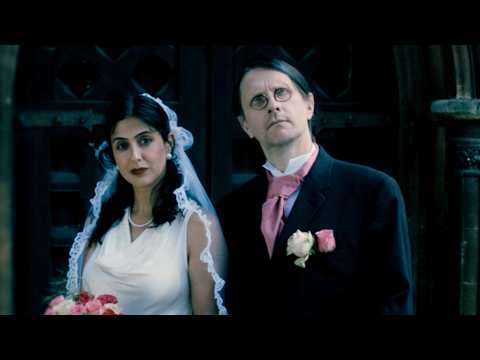
The video was directed by Mike Bennion. At the centre of the story is a village wedding, where the main characters were played by Wilson himself and his partner Rotem. However, the familiar celebration gradually turns into a mystical scene: among the old graves the former inhabitants of the village appear, and the boundary between past and present begins to dissolve.
This is not a separate fantasy of the director, but a continuation of the world of the entire album — a fictional British village that exists as if beyond any particular time.
Wilson describes it as a hidden reality where rural life, folklore, painting, literary mysticism and the memory of several generations come together in a single space. The musician himself calls the album “54 minutes of cinema for the ears”. Steven Wilson
A sound you can touch
While working on Requiem for a Village, Wilson wanted to return to a more organic and recognisably human way of making music.
He used analogue synthesisers, did not try to tune every instrument perfectly, and deliberately left the living unevenness of performance in the recordings. What is more, the musician took up the violin, the oboe and the drums — instruments he does not command as a professional player.
Such a choice might have seemed a limitation. But it was precisely the unfamiliarity with habitual techniques that allowed him to search for sound without a ready-made route.
When a person has perfect command of an instrument, the hands often move along familiar trajectories. When there is no habitual skill, however, every touch becomes a question. The performer listens more attentively to the sound that arises, and the unexpected becomes a full-fledged participant in the creative act.
According to Wilson, he wanted to create music in which metaphorical fingerprints can be heard — human gestures and imperfections that cannot be fully reproduced by software. The Prog Report
When a mistake ceases to be a mistake
Modern studio software can do almost anything: correct pitch, align rhythm, clean up breathing, assemble flawless performances from many separate fragments.
These capabilities in themselves do not deprive music of life. Technology can be a subtle and expressive instrument. The question arises when correction becomes an automatic reaction, and an individual feature of performance is perceived as a defect.
A slight deviation from the rhythm can convey inner tension. An imperfectly held note — fragility. The rustle of fingers, a breath before a phrase or a barely noticeable instrument going out of tune tell the listener: a living person was present here.
In such music, what matters is not the mathematical precision of each element, but their shared truthfulness.
That is precisely why imperfection can become not a flaw in a work, but its signature — that inimitable movement by which we recognise the author.
The “innocent” ear
Wilson says that working with unfamiliar instruments restored his sense of creative innocence. He did not try to prove his own mastery in advance, but watched where the sound that arose would lead.
In this approach, the author's very position changes. He no longer controls the work down to the last detail, but enters into an interaction with it.
The musician makes a movement. The instrument responds. The space adds its own resonance. Chance offers a direction that was not in the original conception. And the composition gradually emerges from the relationships between all the participants in the process.
Thus the author does not lose his mastery — he allows mastery to become free enough to hear the unknown.
The collective memory of a single place
The world of Requiem for a Village is created not only by sound. In it, British folklore, ancient rites, rural architecture and the mystical literature of M. R. James and Algernon Blackwood come together. Among his visual reference points, Wilson names the painting of Stanley Spencer and the atmosphere of the film The Wicker Man.
The actor David Tennant, who voiced the narrative passages, the musician Andy Partridge, who wrote the lyrics for the narrator and some of the song lines, the multi-instrumentalist Randy McStine, the drummer Russell Holzman and the singer Katherine Priddy joined the work on the album. The Prog Report
That is why the village becomes not merely a backdrop. It seems to possess a memory of its own, made up of the voices, traces and stories of many people.
Each one brings a separate timbre — and only in their union does a whole appear.
A human presence cannot be copied
The story of Steven Wilson's new album does not propose abandoning technology and returning to the past. It reminds us of something else: an instrument should expand creative freedom, not erase the uniqueness of the one who uses it.
Precision can make music clean. But it is presence that makes it alive.
Our uniqueness manifests itself not in spite of unevenness, pauses and unexpected turns, but together with them. In every movement there remains a pattern of its own — of attention, experience and inner resonance.
Perhaps true mastery begins not where a person never makes a mistake again, but where he is able to hear: what new door has opened in the imperfection he has created.
And then music preserves not only the notes. It preserves the touch of the one who once allowed them to sound.


