


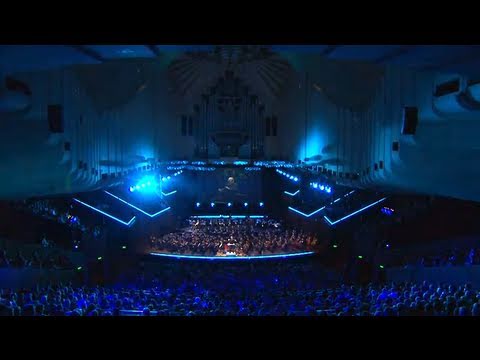
On August 15, 2026, Mothership — a major work by American composer Mason Bates for symphony orchestra, electronics, and improvising soloists — was performed again at the Computer History Museum in Mountain View, California.
The Googler Orchestra, an independent collective of Google employees for whom music remains an integral part of life alongside technology and creativity, performed it.
This return proved to be more than a coincidence; it brought things full circle.

Mothership was commissioned by the YouTube Symphony Orchestra and first premiered on March 20, 2011, at the Sydney Opera House, conducted by Michael Tilson Thomas. Approximately two million viewers worldwide watched the premiere online.
Fifteen years later, the music returned to the people connected with the company that originally brought it to life. Mason Bates himself called it a “full circle moment.”
The Orchestra as Cosmic Space
In Mothership, the orchestra isn't merely a collection of instruments. It transforms into a vast, moving organism — a mothership surrounded by electrical impulses, rhythms, and sound currents.
At certain moments, individual musical entities seem to dock with it. Soloists join the collective sound, improvise on the work's thematic material, and then detach from the orchestral mass again, leaving their imprint.
Bates conceived the idea in the New York subway. Observing how people boarded a train at one station and exited at another, the composer envisioned a musical metaphor: a collective flow that each participant briefly joins, contributing their unique voice, before continuing on their journey.
During the August 15 performance, an electric guitar, electric bass, and Marimba Lumina — an electronic MIDI instrument enabling digital sound control via touch — joined the orchestra.
This isn't a clash between classical music and technology. It's a symbiosis: they become parts of one expanded musical body.
Unity Does Not Require Uniformity
In this music, every voice retains its nature and independence.
The orchestra does not absorb the soloist.
The soloist does not try to overpower the orchestra.
They meet, exchange impulses, transform each other—and then part, having altered the collective sound.
Perhaps this is why Mothership resonates so strongly today, as humanity continues to learn the art of coexistence.
We recall a truth once forgotten: unity is not uniformity. It is a space capacious enough to embrace numerous independent voices and blend them into a single coherent movement.
Each of us carries our own frequency. But in the moment of encounter, our individual lines converge into music that never existed before.
Into new music.
What Do We Feel as It Approaches?
The mothership in this narrative is an artistic metaphor. Yet art sometimes grasps changes before we can even name them.
As it approaches, one might sense not the arrival of an external entity that will rearrange our lives, but rather the awakening of a more integrated space within ourselves.
A space where science meets art, technology converges with emotion, and the individual voice merges with the collective field.
The mothership approaches whenever disparate parts begin to recognize each other.
When we cease fighting for the right to sound louder—and begin to hear the whole.
When everyone remains themselves, yet senses a shared orbit. Perhaps the ship doesn't appear in the sky at all.
Perhaps it first manifests in our perception—as a readiness to join a grander symphony of Life.
And then music becomes not an accompaniment to its approach.
It becomes a signal: we are ready.


